احدث المقالات
Studying Human Medicine in Malaysia – Costs & Recognition

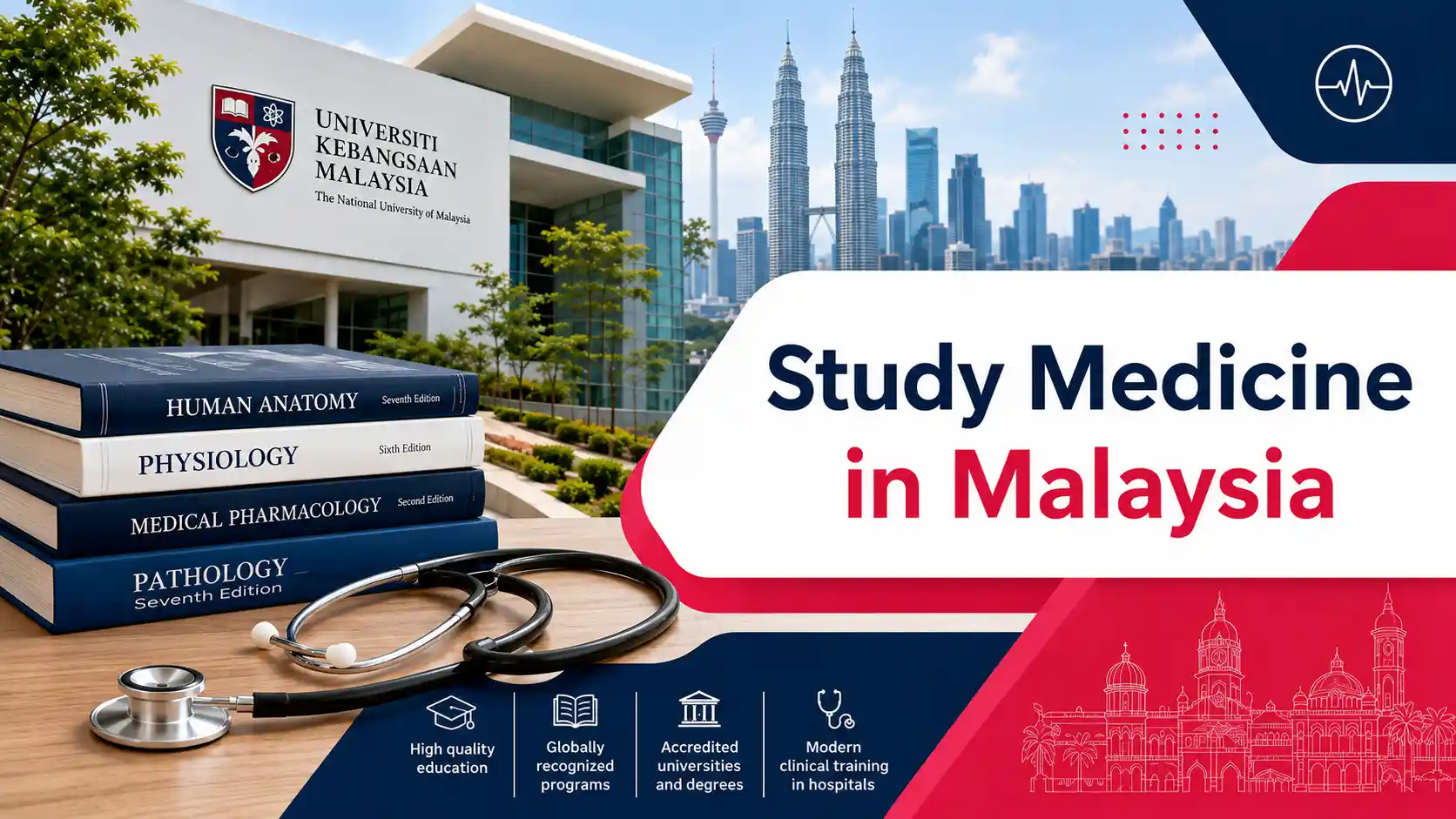
Five years of study and tens of thousands of dollars, and the question you must ask today before any step: Will your Malaysian medical degree be accepted in your country after graduation?
Studying human medicine in Malaysia is a real option for thousands of Gulf and Arab students every year. An MBBS degree accredited by WHO and MQA, fully English-medium instruction, modern teaching hospitals, and total cost starting from $99,000 compared to $400,000 in Australia. But recognition differs from one university to another and from one country to another, and verification before enrollment makes the difference between a right decision and wasted years.
Advantages of Studying Human Medicine in Malaysia
Malaysia has entered the international medical education map seriously for practical reasons, not just because it’s a great destination. Study is fully in English, the degree is accredited by Malaysian Medical Council and MQA and listed in the WHO database, and teaching hospitals are on campus or nearby in most universities.
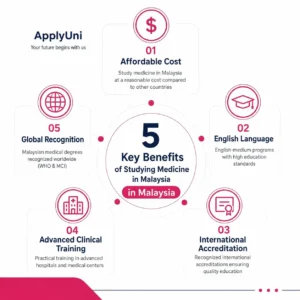
Advantages of studying human medicine in Malaysia
Five points make Malaysia a real medical choice:
- Total cost: $60,000 to $90,000 for the full program in private universities, compared to £300,000 in Britain and over $400,000 in Australia
- Language of instruction: English is the primary language in all medical courses
- Duration: 5 years to obtain MBBS degree in two stages: Pre-clinical (2 years) and Clinical (3 years)
- International accreditation: Listed in FAIMER World Directory and WHO list, with recognition in Saudi Arabia, Jordan, and Gulf countries for specific universities
- Clinical training: Modern teaching hospitals provide training on real patients starting from the third year
Best Universities for Human Medicine in Malaysia
Not all Malaysian universities accept international students in medicine. Public universities are mostly reserved for Malaysians, and the only exception is Universiti Malaysia Sabah which accepts international students in English. The actual option for Gulf and Arab students is private universities, and these are the most prominent.
MAHSA University
- Medical college founded in 2009 in Kuala Lumpur
- Total fees: ~$77,000
- Accreditations: MMC, MQA, FAIMER
- Has its own teaching hospital
MAHSA is fully specialized in health sciences, and this specialization means all its resources are directed toward medical education. Its curriculum is built on case-based clinical learning from the first year, and this makes the transition to the clinical stage smoother than many competing universities.
Details: MAHSA University
UCSI University
- Location in Kuala Lumpur
- Total fees: ~$79,000
- Accreditations: MMC, MQA, ABET, ACBSP, WHO
- Integrated teaching hospital
UCSI has an advantage many private medical universities don’t have: multiple international accreditations beyond the basic Malaysian accreditation. If you’re thinking about obtaining a medical license in more than one country after graduation, this diversity in accreditations opens wider options for you.
IMU – International Medical University
- Location in Kuala Lumpur
- Fees: ~$44,700 (simplified pathway) or up to ~$127,600 (full pathway)
- Accreditations: MMC, MQA, WHO (IMED)
- Program is 5+1 years (6 years total)
IMU is one of the oldest and most experienced private medical universities in Malaysia. It features partnerships with British, Irish, and Australian universities that allow students to complete final years abroad and obtain a dual degree. Fees vary significantly depending on the pathway you choose.
Cyberjaya University
- Founded in 2005 in Cyberjaya, Selangor
- Total fees: ~$69,000
- Accreditations: MMC, MQA
- Integrated teaching hospital
Cyberjaya is the lowest cost among accredited private medical universities, and this makes it a real attraction point. But its international reputation is less than MAHSA, UCSI, and IMU, and this may affect its degree acceptance in some countries.
Details: Cyberjaya University
Monash Malaysia
- Founded in 2010 as a self-accredited university in Penang
- QS Medical Ranking: 222 globally
- Accreditations: MQA self-accredited, Medical Council of India
- Accredited teaching hospitals
Monash is not a Malaysian private university in the traditional sense, but a branch of Australian Monash University ranked 57 globally. Its degree carries the weight of the Australian parent university, and its medical ranking of 222 globally makes it the strongest academically among all medical universities in Malaysia. Cost is higher, but the value is completely different.
Cost of Studying Human Medicine in Malaysia
The question every student asks before any step: How much will this decision actually cost me? The real answer needs more than just the tuition fee number on the university website.
Tuition Fees Cost
Monthly Living Cost
Comparison with Other Countries
The difference is clear: In Malaysia you get an internationally accredited MBBS degree at a cost equal to one-quarter of what you pay in America, with the same language and same international academic standards.
Learn about: Cost of Living in Malaysia for Arab Students
Admission Requirements for Human Medicine in Malaysia
Medicine is one of the clearest majors in admission requirements. There’s no room for leniency in academic requirements, but requirements in Malaysia are more flexible than you might expect compared to Britain or Australia.
High School Requirements
- Minimum GPA of 80% or 3.5 out of 4.0
- You must have studied Biology, Chemistry, and Physics or Mathematics
- Science track is mandatory, arts track is not accepted in medicine
English Language Requirement
- IELTS: Minimum 6.0
- TOEFL: 550 paper-based or 80 computer-based
- Some universities accept their own internal tests for students without IELTS
Required Documents
- High school certificate authenticated and attested
- English language certificate
- Valid passport
- Personal photos
- Medical examination before enrollment
Important point: Medical majors require a personal interview in most universities, and it is a real part of the admission decision, not a formality. Prepare for it seriously.
Is the Malaysian Medical Degree Recognized in Saudi Arabia, Jordan, and Gulf Countries
This question should be the first thing you ask before enrollment, not after graduation.
The short answer: Yes, but with conditions that differ from one country to another, from one university to another, and from one major to another.
Recognition in Saudi Arabia
The Saudi Ministry of Education maintains an official list of recognized medical universities outside the Kingdom. Accepted Malaysian universities include: University of Malaya, UKM, USM, Monash Malaysia, and UCSI. The basic condition is that study must be fully in-person and courses must comply with Saudi standards.
Recognition in Jordan
The Jordanian Ministry of Higher Education has an official portal for recognition requests and degree equivalency at: rnji.mohe.gov.jo. The basic condition is that the institution must be accredited in the country of study and study was regular and in-person.
Recognition in Gulf Countries
Read also: Malaysian Universities Recognized in Gulf Countries
What You Must Know Before Enrollment
Academic recognition of the degree is one thing, and professional licensing to practice medicine is another. Even if your degree is recognized, you will need to pass professional licensing exams in your country after graduation. In Saudi Arabia there is the Saudi Commission for Health Specialties exam, and in the Gulf generally each country has its own specialized body.
The bottom line: Verify the university in your country’s Ministry of Education list before enrollment, and verify professional licensing requirements after graduation. Both together paint the complete picture.
Duration of Studying Human Medicine in Malaysia and Its Stages
The medicine program in Malaysia extends for 5 years to obtain the Bachelor of Medicine, Bachelor of Surgery degree known as MBBS. The only exception is IMU which offers a 6-year pathway that includes an additional year for university transfer.
Theoretical Stage – First and Second Years
The first two years focus on building the medical foundation: Anatomy, Physiology, Biochemistry, Microbiology, and Pathology. Study is a mix of theoretical lectures and practical laboratories. In some universities like MAHSA, simplified clinical cases start from the first year to accelerate linking theory to reality.
Clinical Stage – Third, Fourth, and Fifth Years
This stage is the core of medical education. The student moves from the lecture hall to the teaching hospital and deals with real patients under the supervision of specialized doctors. Training covers Internal Medicine, Surgery, Pediatrics, Obstetrics and Gynecology, and Psychiatry.
The quality of this stage depends directly on the quality of the teaching hospital. Therefore, when comparing universities, don’t just look at fees, look at the size of the teaching hospital, number of beds, and diversity of cases you will deal with.
Studying Medicine in Malaysia After Bachelor’s Degree
If you hold a bachelor’s in health sciences or pure sciences and didn’t study medicine from the beginning, there is an option many don’t know about: the Graduate Entry Medicine program.
Malaysia offers this program, the first and only of its kind in the country. The idea is simple: Instead of starting from scratch, you enter directly into an intensive medical pathway that leverages your scientific background.
Admission requirements for this program:
- Bachelor’s in Medicine, Health Sciences, Pure Sciences, or Applied Sciences
- Accepted majors such as: Biomedical Science, Optometry, Nutrition Science, Dietetics, Audiology, Speech Science
- Cumulative GPA of at least 3.30 out of 4.00
Studying PhD by Distance Learning in Malaysia
A question many ask: Can you study medicine or obtain a medical PhD by distance learning in Malaysia?
The direct answer: No, not for clinical medical majors. Malaysian Medical Council does not recognize distance learning at all for medical majors, and recognition in Gulf countries and others explicitly requires that study be regular and in-person.
As for PhD in non-clinical majors like scientific research and basic medical sciences, some Malaysian universities offer them in hybrid or partially distance format, but each case must be verified individually.
Job Opportunities After Graduating from Malaysian Medicine
Working in Malaysia: An international doctor graduating from a Malaysian university cannot practice medicine in Malaysia directly. They need a special license from Malaysian Medical Council, and working as a foreign doctor in Malaysia is limited and subject to strict restrictions.
Returning to work in the Gulf: This is the real goal for most Gulf students. The picture is clear:
- The degree must be from a university recognized in your country
- You will need to pass the professional licensing exam in your country after graduation
- Job opportunities are very good if the university is accredited and the major is accepted
Students who graduate from Monash, UCSI, IMU, and UofM find a relatively easier path to obtain professional licensing in Gulf countries compared to graduates of less renowned universities.
How to Apply for Admission to Medicine in Malaysia via ApplyUni
Applying for the medicine major in Malaysia and studying in Malaysia is more complex than other majors. More documents, harder requirements, and the personal interview is part of the equation. ApplyUni handles this entire path:
- Verify university and major recognition in your country before any step
- Evaluate your academic file and choose the most suitable university for you
- Prepare the admission application and all required documents
- Prepare for the personal interview
- Manage study visa procedures
- Reception in Malaysia and arrange accommodation upon arrival
Studying medicine is a decision that affects at least ten years of your life. Start with the right step.
FAQ
Is studying medicine in Malaysia recognized
Yes, the degree is accredited by Malaysian Medical Council and MQA and listed in the WHO database. Recognition in Saudi Arabia, Jordan, and Gulf countries exists for specific universities, and verifying your country’s Ministry of Education list before enrollment is a step that cannot be skipped.
What is the best medical university in Malaysia
There is no one-size-fits-all answer. Monash Malaysia is the strongest academically with its medical ranking of 222 globally. University of Malaya is the strongest among public universities. MAHSA, UCSI, and IMU are strong options for international students in the private sector. The choice depends on your budget and the universities specifically recognized in your country.
How much does studying medicine in Malaysia cost
Tuition fees alone range from $69,000 to $127,000 for the full program depending on the university. With living costs for 5 years, the total cost ranges from $99,000 to $177,000.