احدث المقالات
Malaysian University Specializations 2026 – Specializations

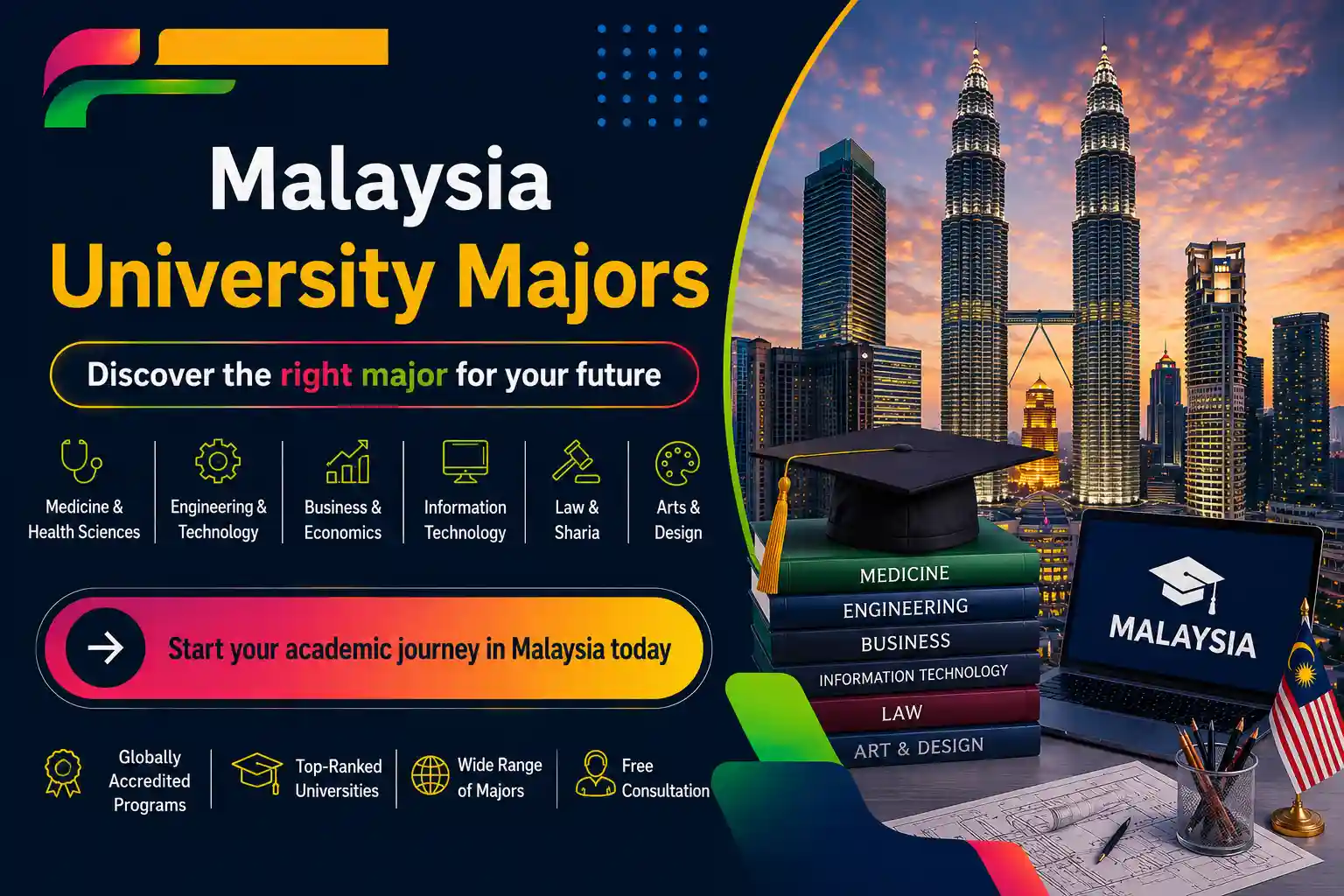
More than 150,000 international students study in Malaysia every year, and the number of Arab students is continuously growing. The reason is not simply the low cost, but a rare combination of globally ranked universities, degrees recognized across the Gulf and beyond, a comfortable Islamic environment, and fees that cannot be compared to what European and American universities charge.
But cost alone is not enough to make the decision. The most important question every student faces before traveling is: which of the Malaysian university specializations is right for me? And which university suits their academic profile, grades, and budget?
Overview of University Education in Malaysia
Malaysia is not just a cheap study destination. Over twenty years it has transformed into a genuine regional educational hub, hosting today complete branches of British and Australian universities, public universities ranked among the world’s top 100, and more than 400 private higher education institutions catering to different levels and budgets.
What distinguishes Malaysia from other Asian destinations is the international recognition of its degrees. Major public universities are accredited by the Malaysian Qualifications Agency MQA, and many of their engineering programs are listed under the Washington Accord, meaning the degree is professionally accepted in more than twenty countries.
Types of Universities in Malaysia
Before choosing a specialization, you need to understand the difference between university types because this difference directly affects your cost, admission requirements, and degree value.
Study Levels at Malaysian Universities
Malaysia allows you to study at whichever level fits your current academic situation.
The Diploma lasts two to two and a half years, suitable for those wanting quick entry into the job market or a bridge to the Bachelor’s degree through the direct transfer system. The Bachelor’s degree takes three to four years for general specializations, and five to six years for medicine and dentistry, with an Honours option available at many universities. The Master’s takes one to two years, either by Coursework or by Research. The PhD runs three to five years for those seeking deep academic and research specialization, with scholarships available at many public universities.
Best Malaysian University Specializations by Field
Malaysia offers more than a thousand university specializations. The following focuses on the most in-demand fields for Gulf students with accurate data for each.
Medical and Health Specializations
Medicine in Malaysia is one of the most sought-after fields by Gulf students, and the reasons are clear: degrees are accredited in most Gulf countries, fees are far lower than Europe or Australia, and Malaysian hospitals provide solid clinical training. However, fees here are higher than other specializations, and admission is more competitive.
Human Medicine MBBS
Five years of study combining foundational sciences with clinical training in hospitals. Graduates with an MBBS from an accredited Malaysian university can register with medical authorities in most Gulf countries after meeting local licensing requirements.
Best universities: University of Malaya UM the highest-ranked nationally, IMU the first private medical university in Malaysia, MAHSA with modern medical facilities, Universiti Sains Malaysia USM with strong medical research, and Monash Malaysia with an Australian degree.
Annual fees from $12,000 to $25,000 depending on the university. Public universities are cheaper but admission is more competitive. Admission requirements: grade of 80% or above in the science stream with passes in Biology, Chemistry, and Physics or Mathematics, and IELTS 6.0 minimum.
Dentistry
Five years with curricula covering diagnosis and treatment of oral and dental diseases alongside intensive clinical training in university clinics. The specialization is strongly in demand in the Gulf job market in both the public sector and private clinics.
Best universities: UM, MAHSA, USM, the International Islamic University Malaysia IIUM, and AIMST. Fees from $10,000 to $22,000 annually. Admission requirements: 75% in the science stream with Biology and Chemistry mandatory, and IELTS 6.0.
Pharmacy
Four years covering pharmacology, pharmaceutical formulation, and drug interactions. Pharmacy graduates from Malaysia find wide employment options including community pharmacies, hospitals, pharmaceutical companies, and research.
Best universities: UM, USM, UPM, MAHSA, and IMU. Fees from $8,000 to $18,000 annually. Admission requirements: 75% in the science stream with Chemistry mandatory, and IELTS 5.5 to 6.0.
Nursing and Physiotherapy
Two distinct specializations that share high demand and the ability to work in Gulf countries and abroad. Nursing focuses on patient care in hospitals and clinics, while physiotherapy centers on rehabilitation and treatment of bone and muscle injuries.
Best universities: MAHSA, Manipal, UM, USM, and Cyberjaya University. Fees from $5,000 to $12,000 annually. Admission requirements: 65% in the science stream with Biology preferred, and IELTS 5.0 to 5.5.
Engineering and Technology Specializations
Engineering in Malaysia has a clear competitive advantage: many programs are accredited under the Washington Accord, meaning graduates can register as practicing engineers in more than twenty countries through simplified procedures. Add to this that fees at public universities are highly competitive compared to any Western destination.
Civil and Architectural Engineering
Designing and building bridges, roads, buildings, and infrastructure. Graduates are particularly in demand in the Gulf market with the massive construction and development waves in Saudi Arabia, the UAE, and Qatar.
Best universities: UTM the national leader in engineering, UTP, UM, and UiTM. Fees from $4,000 to $10,000 annually. Admission requirements: 70% in the science stream with Physics and Mathematics mandatory, and IELTS 5.5.
Electrical and Mechanical Engineering
Electrical covers power systems, electronics, and communications, while mechanical includes machine design, cooling systems, and manufacturing. Both specializations are in demand in oil, energy, and heavy industry sectors.
Best universities: UTM, UTP, UM, and MMU. Fees from $4,000 to $10,000. Admission requirements: 70% in the science stream with Physics and Mathematics, and IELTS 5.5.
Petroleum and Energy Engineering
A specialization with a unique character in Malaysia. UTP was founded with direct funding from Petronas and provides students with guaranteed training at Malaysia’s largest oil company. Those who study petroleum engineering here graduate with real practical experience that is difficult to gain elsewhere.
Best universities: UTP is the clear leader in this specialization, followed by UTM and UM. Fees from $6,000 to $14,000 annually. Admission requirements: 75% in the science stream with Physics and Chemistry, and IELTS 5.5 to 6.0.
Computer and Software Engineering
Designing computer systems and developing software and applications. The job market is constantly growing, and graduates can work in Malaysia, the Gulf, or freelance from anywhere.
Best universities: UTM, APU, MMU, UM, and Taylor’s. Fees from $4,500 to $12,000. Admission requirements: 65% in science or arts stream with Mathematics preferred, and IELTS 5.0 to 5.5.
Artificial Intelligence and Cybersecurity
The two most in-demand specializations in the global job market through 2030. AI covers machine learning, data analysis, and robotics, while cybersecurity addresses protecting systems and networks from breaches. The global shortage of specialists in these two fields means graduates find job opportunities easily and at high salaries.
Best universities: APU the strongest in cybersecurity at the regional level, MMU, UTM, and Sunway. Fees from $5,000 to $14,000. Admission requirements: 65% with Mathematics and Computer Science preferred, and IELTS 5.5.
Business Administration and Finance Specializations
Business administration in Malaysia is one of the most flexible specializations. Admission is easier, fees are lower, and it suits students from both the science and arts streams. If you are planning a career in the world of business, finance, and management, Malaysian universities offer programs accredited by international bodies such as ACCA and CIMA.
General Business Administration
A specialization covering marketing, human resources, operations, and strategy. Graduates find opportunities in virtually any sector, from banks to companies to government organizations.
Best universities: Taylor’s the strongest in business, Sunway, UM, MSU, and APU. Fees from $3,200 to $8,000. Admission requirements: 60% or above from any stream, and IELTS 5.0 to 5.5.
Accounting and Finance
A specialization in demand everywhere because every company needs accountants. Some programs in Malaysia are accredited by ACCA, meaning an exemption from professional exams that allows graduates to obtain the international certification faster.
Best universities: Taylor’s, Sunway, UM, and UPM. Fees from $3,500 to $9,000. Admission requirements: 65% with Mathematics preferred, and IELTS 5.5.
Digital Marketing and Entrepreneurship
Two specializations seeing rising demand with the digital transformation in Gulf markets. Digital marketing opens doors to advertising agencies, e-commerce companies, and freelance work. Entrepreneurship suits those who want to build their own business armed with theoretical and practical tools.
Best universities for marketing: Taylor’s, Sunway, MMU, and APU. For entrepreneurship: Taylor’s, Sunway, UM, and MSU. Fees from $3,500 to $9,000. Admission requirements: 60% and IELTS 5.0.
Computer Science and Information Technology Specializations
This field is seeing demand growth that other specializations simply do not match. Every company needs an IT specialist, every institution needs cybersecurity, and every digital product needs a developer. Malaysia offers specialized programs here at reasonable costs, with universities like APU building a name in this field at the regional level.
Available specializations include Data Science, Cybersecurity, Software Engineering, and Information Technology and Networking. Annual fees from $4,000 to $13,000. Admission requirements for most: 65% with Mathematics and IELTS 5.0 to 5.5.
Creative and Media Specializations
For those drawn to the creative side, Malaysia offers a good environment for design, media, and hospitality specializations. The Malaysian creative industry is growing, and universities like Taylor’s, Sunway, and Limkokwing offer practical programs tied to the job market.
Available specializations include Graphic Design and Multimedia, Digital Media and Journalism, Hospitality and Tourism Management, and Culinary Arts. Fees from $3,500 to $10,000. Admission requirements start from 55% and IELTS 5.0, with a Portfolio required for design.
Postgraduate Specializations
Malaysia is a growing destination for postgraduate study. Fees are far lower than Europe and America, and public universities offer PhD scholarships covering fees and a monthly stipend for outstanding researchers.
The Master’s is either by Coursework from one and a half to two years, or by Research from two to three years. Admission requirements: Bachelor’s with a GPA of 3.0 out of 4.0, IELTS 6.0, and work experience preferred for MBA. Fees from $4,000 to $15,000 annually.
The PhD runs three to five years with original research under academic supervision. Admission requirements: Master’s with a GPA of 3.5 or an excellent Bachelor’s with research experience, a Research Proposal, and a Supervisor’s approval. Fees from $3,000 to $10,000 annually, which is actually lower than the Master’s at many universities.
Top 10 Specializations in Malaysia by Cost and Employment 2026
This table summarizes the best specializations based on three criteria: annual cost, job opportunities, and expected starting salary. Data is updated for 2026.
Choosing from these specializations depends on your priorities. If cost is most important, business administration and computer science are the logical choices. If career prospects are your concern, AI and cybersecurity are the smartest options over the coming decade. And if you want a guaranteed high salary, medicine and petroleum engineering are the right path.
How to Choose the Right Specialization for You
Choosing a specialization is not a question of what is best in general, but what is best for you specifically. Five questions to help you make the right decision.
Five Questions Before Making the Decision
- First question: what is your annual budget including fees and living costs? If your budget is $8,000 to $12,000 annually, public universities and non-medical specializations are your range. If it is higher, the door opens to medicine and prestigious private universities.
- Second question: will you work in Malaysia after graduation or return to your country? Those wanting to work in Malaysia choose locally in-demand specializations like engineering and technology. Those returning to the Gulf first verify the university and specialization recognition in their country.
- Third question: what was your high school grade? A grade of 80% or above opens every door including medicine and competitive engineering. A grade between 65 and 80% suits most business, computer science, and general engineering specializations. A grade below 65% starts with a Diploma or business administration and transfers to the Bachelor’s later.
- Fourth question: do you prefer the practical side or the analytical? Those who lean toward application are suited to engineering, medicine, design, and hospitality. Those who lean toward analysis and research are suited to computer science, accounting, and postgraduate studies.
- Fifth question: what do you genuinely feel passionate about? A specialization you do not enjoy will be hard to persist in even if the salaries are high. Choose what you can excel at because excellence is what opens the doors to real salaries.
Decision Matrix by Priority
Admission Requirements for Malaysian University Specializations
Requirements differ between universities and specializations, but there are general requirements that apply to everyone and specific requirements for competitive specializations.
General Requirements for All Specializations
Academic credentials include a high school certificate with an official transcript translated into English. Required personal documents are a passport valid for at least 18 months, personal photos with a white background, and a CV for some specializations. English language proof is either IELTS from 4.0 to 6.5 depending on the specialization or alternatives such as TOEFL or PTE. Those without a language certificate can enroll in a Foundation English year at the university itself.
Special Requirements for Competitive Specializations
Human medicine and dentistry require a grade of 80% or above in the science stream with mandatory passes in Biology, Chemistry, and Physics or Mathematics, IELTS 6.0, and sometimes a personal interview or entrance test. Engineering requires 70% in the science stream with Physics and Mathematics mandatory and IELTS 5.5. MBA requires a Bachelor’s with a GPA of 3.0 out of 4.0, work experience preferred, and IELTS 6.0. Law requires 70% with IELTS 6.0 and sometimes a personal interview. Design and media require 60% with a Portfolio mandatory at most universities.
Study Costs for Malaysian Specializations
The total cost includes tuition fees, monthly living expenses, and initial costs when applying.
Tuition Fees by University Type
Monthly Living Costs
Application Steps for Malaysian University Specializations
The process is organized and clear if you follow the steps in the correct order.
- Choose two or three universities as primary and backup options based on specialization, cost, and ranking, and verify the university is recognized in your country before anything else
- Prepare your documents: certified and translated high school certificate and transcript, passport, language certificate if available, and additional documents depending on the specialization
- Apply through the university’s official website, fill the form accurately, upload the required documents, and pay the application fee
- Wait for the acceptance letter within two to six weeks, review the conditions, sign the acceptance, and pay the first installment
- The university submits your student visa application to EMGS on your behalf, with processing taking four to eight weeks and fees from $150 to $300
- Book your flight and arrange temporary accommodation, and bring all original documents with you
- After arrival: complete the mandatory medical examination, obtain your Student Pass, and open a bank account
FAQ
What are the best specializations in Malaysia for Gulf students?
Human medicine, engineering especially petroleum and electrical, business administration, artificial intelligence, and cybersecurity are among the best options due to international recognition, good salaries, and ease of employment in the Gulf after graduation.
Are Malaysian university degrees recognized in Arab countries?
Yes, major universities like UM, USM, Taylor’s, Sunway, and Monash are recognized in most Arab countries. But verify the specific university and specialization with your country’s Ministry of Education before applying because the lists change.
How much does it cost to study medicine in Malaysia?
From $8,000 to $15,000 annually at public universities, and from $12,000 to $25,000 at private ones. The large gap compared to Europe and Australia makes Malaysia a logical choice for those who do not receive a government scholarship.
Can I study in Malaysia without IELTS?
Yes. You can study by enrolling in a Foundation English year at the university, submitting alternative tests like TOEFL or PTE, or using the university exemption for those who completed secondary school entirely in English.
What are the easiest specializations to get admitted to?
Business administration, information technology, media, and TESOL English teaching are among the easiest specializations, accepting students at 60% with no specific subject requirements at most universities.