احدث المقالات
Studying Engineering in Malaysia 2026 – Civil, Aviation and Costs

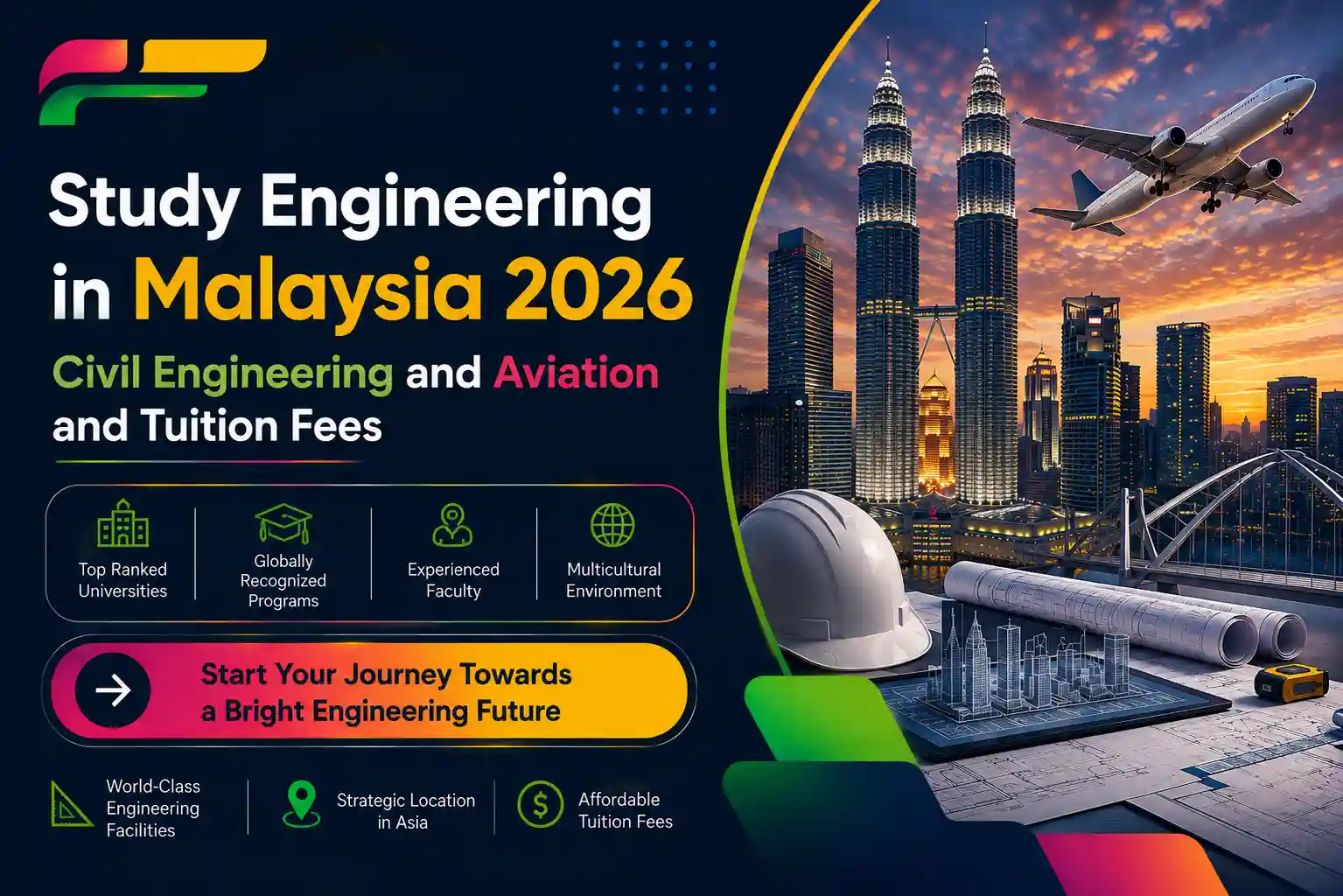
Over recent years, Malaysia has become a serious destination for Arab engineering students looking for an internationally recognized degree at a cost that cannot be compared to European or American universities. Major public universities such as UTM and UM offer engineering programs accredited by the Malaysian Board of Engineers BEM and the Washington Accord, while Malaysia hosts full branches of prestigious British and Australian universities that grant the same original degree at a much lower cost than studying at the main campus. This guide covers everything you need before making the decision: specializations, universities, requirements, costs, and degree recognition steps after graduation.
Why Engineering in Malaysia?
The reasons are practical, not marketing talk. Anyone comparing Malaysia with other destinations finds a real difference across several areas.
Annual fees at public universities range between $2,500 and $5,500, a figure far from what UK or US universities charge. The study environment is Islamic and comfortable with large Arab communities in Kuala Lumpur, Shah Alam, and Johor Bahru. Thanks to Malaysia’s membership in the Washington Accord, engineering degrees accredited by BEM are recognized in more than twenty countries including Australia, Canada, and Singapore. Malaysia also hosts regional offices of major global technology and industrial companies, providing genuine training opportunities during studying in Malaysia.
Engineering Specializations Available in Malaysia
Malaysian universities cover a wide range of engineering specializations suited to the Gulf and global job markets.
- Civil Engineering: includes structural engineering, transportation engineering, and infrastructure
- Mechanical Engineering: mechanical design, energy, and manufacturing
- Electrical and Electronic Engineering: one of the most in-demand specializations due to its connection to modern technology
- Computer Engineering and Information Technology: a rapidly growing field with the digital revolution
- Chemical Engineering: linked to the oil, gas, and petrochemical industries
- Mechatronics Engineering: a blend of mechanics, electronics, and systems programming
- Environmental and Industrial Engineering: responding to sustainability and Industry 4.0 needs
- Biomedical Engineering: an emerging specialization combining engineering and medicine
Admission Requirements for Engineering Programs
Requirements vary slightly between universities but agree on a consistent set of core criteria.
High School Certificate and Grade
A high school certificate with successful results in Mathematics and Physics at approximately 70% or above is required. Chemical engineering specializations also require a good grade in Chemistry. Prestigious universities like UM and UTM require higher grades due to competition for available seats.
English Language Requirement
IELTS with a minimum overall score of 6.0 is the standard requirement. Alternatives available for those without the certificate include TOEFL iBT with a score of 80 or above, an intensive English program offered by the university before the start of study which is available at universities such as APU and UCSI, or a full exemption for those who completed secondary school entirely in English according to each university’s policy.
Foundation Year
Those who do not meet the grade or language requirement enroll in a Foundation in Engineering year before starting the Bachelor’s degree. Those who fully meet the requirements can enroll directly in the first year without waiting.
Required Documents
- Certified and translated high school certificate and transcript
- Valid passport with at least 18 months remaining
- Recent personal photos with a white background
- IELTS or TOEFL certificate if available
- Fully completed application form
- Recommendation letter or personal statement at some universities
Duration of Engineering Study in Malaysia
The Bachelor’s degree duration ranges between 3.5 and 4 years depending on the specialization and university. Some private universities shorten the duration to 3.5 years through a three-semester-per-year system. Public universities follow the traditional four-year structure. Those who complete the Foundation year first add one academic year, bringing the total to between 4.5 and 5 years.
Cost of Studying Engineering in Malaysia
Cost depends on the type of university, city, and lifestyle. The figures below are approximate and updated annually.
Annual Tuition Fees Table
Always confirm the actual fees directly from the university before applying, as figures change annually.
Monthly Living Costs
Monthly living costs range between $320 and $530, equivalent to 1,500 to 2,500 Malaysian ringgit, distributed roughly as follows: accommodation between $130 and $320 and significantly lower outside Kuala Lumpur, food between $110 and $160, transport between $22 and $33, and internet and communications between $11 and $22.
When applying for the first time, add: the student visa EMGS between $700 and $1,000, the medical examination between $60 and $80, and mandatory health insurance between $100 and $250 annually.
Best Engineering Universities in Malaysia
The choice divides practically into two paths: lower cost with strong local accreditation, or international degree prestige.
Public Research Universities
The five major public universities are the best option for those seeking high quality at lower cost. University of Malaya UM is the highest-ranked nationally and one of the most prestigious universities in Southeast Asia. Universiti Teknologi Malaysia UTM is the strongest in engineering across its various branches. UKM excels in electrical engineering and systems engineering. USM is known for chemical and industrial engineering programs. UPM stands out in environmental, agricultural, and mechanical engineering.
Private Universities and International Branches
For those preferring admission flexibility or an international degree, Taylor’s, UCSI, and APU stand out among local private universities, alongside international branch campuses including Monash Australia and Nottingham and Heriot-Watt from the UK, all granting the same degree as the main campus.
Quick Comparison Table
Academic and Professional Accreditation of an Engineering Degree
Understanding the difference between accreditation levels is essential before choosing a university or program.
The Malaysian Qualifications Agency MQA is the government body responsible for accrediting all academic programs in Malaysia. Any engineering program accredited by MQA means it is officially recognized within Malaysia and meets education quality standards. The Board of Engineers Malaysia BEM is the specialized professional body that accredits engineering programs through the Engineering Accreditation Council EAC, a mandatory requirement for anyone wanting to register as a practicing engineer. The Washington Accord includes more than twenty countries committed to mutual recognition of engineering programs accredited by their respective national bodies including BEM, meaning your degree is professionally accepted in those countries.
Before enrolling, verify that the specific specialization and not just the university is actually accredited by MQA and BEM, as some new programs may not yet carry full professional accreditation.
Recognition of an Engineering Degree After Graduation
Equivalency of your degree in your home country is an important step that cannot be overlooked. The more a program is accredited by BEM and the Washington Accord, the faster and simpler the equivalency process.
Equivalency Steps: General Framework
- Have the degree certificate and transcript certified by the Malaysian university, then by the Malaysian Ministry of Higher Education, then by the relevant embassy in Malaysia
- Submit the equivalency application to the competent government body in your country such as the Supreme Council of Universities in Egypt or the Ministry of Education in Saudi Arabia and the Gulf
- Review the course content and compare it with local university curricula to verify equivalency in credit hours and academic content
- Pay the required fees and receive the official equivalency certificate
- Register with the local engineers’ syndicate using the equivalency certificate
Early contact with the official body in your country before final enrollment in any program is the best investment of your time.
Application Steps
- Choose the university and specialization based on your priorities of cost, ranking, and international accreditation
- Verify that you meet both the grade and language requirements, or plan for the Foundation year
- Prepare the required documents, translate, and certify them
- Submit the admission application through the university’s official website and wait for the acceptance letter
- Apply for the student visa EMGS after receiving admission
- Pay fees and arrange accommodation
- Travel and complete official enrollment procedures at the start of the semester
FAQ
Is studying engineering in Malaysia recognized in Arab countries?
Yes, provided the program is accredited by MQA and BEM. This accreditation significantly simplifies equivalency procedures and registration with Arab engineering syndicates.
What is the total cost of four years of engineering study in Malaysia?
At public universities between $12,000 and $20,000 including living costs. At international university branches it may reach $60,000 to $80,000.
Can I study without an IELTS certificate?
Yes, by enrolling in an intensive English program offered by the university before the start of study, or through an exemption for those who studied previously in English.
What is the difference between a public and private university for engineering?
Public universities are lower cost and stronger in research but more competitive in admission. Private universities are more flexible and faster in procedures at a relatively higher tuition.
Is the Foundation year mandatory?
No, it is not mandatory for all students. Those who meet the grade and language requirements can enroll directly in the first year of the Bachelor’s degree.
How long does the degree equivalency process take after graduation?
It typically ranges between two and six months if all documents are certified and complete. The duration varies by the student’s country and the competent authority.