احدث المقالات
Best Countries for University Study: Costs & Universities


Choosing the best countries for university study may be the most important decision in your academic life. But with hundreds of options, how do you know which country truly suits you? Are you looking for high education quality? Reasonable costs? Or guaranteed job opportunities after graduation?
In this guide, you will find an objective and comprehensive comparison between the top 6 study destinations for 2026, with real numbers for costs, university rankings, and available majors. You will discover options that may truly surprise you.
How to Choose the Best Country That Suits You for University Study
Before making the decision to study abroad, you must understand the basic criteria that determine the success of your study experience. Here are the crucial factors to consider:
- Education Quality and Global Rankings Look for countries with universities ranked among the top 500 globally according to QS or Times Higher Education rankings. Academic quality guarantees you an internationally recognized degree and better opportunities in the job market.
- Actual Costs (Tuition + Living) Don’t look only at tuition fees, but calculate the total cost including accommodation, food, transportation, and health insurance. Some countries have low fees but very high living costs.
- Language of Study and Admission Requirements Is study in English available? What are the language requirements (IELTS/TOEFL)? Some universities offer preparatory language programs, and this saves you time and effort.
- Work Opportunities During and After Study Check work regulations for international students, and how easy it is to obtain a work visa after graduation. Some countries provide work visas for up to two years after completing studies.
- Safety and Cultural Environment Choose a politically safe and stable country, and check how welcoming it is to international students. A culturally diverse environment helps you integrate easily.
- Ease of Admission and Visa Procedures Some countries complicate admission and visa procedures, while others provide fast and flexible processes for international students.
Best Countries for University Study 2026
The following table presents an objective comparison between the top 6 study destinations for international students, with updated numbers for 2026:
Important Notes on the Comparison:
- The mentioned figures are averages and may vary by university and major
- Living cost includes: accommodation, food, transportation, and personal expenses
- Some countries offer scholarships that may reduce cost by 30-100%
Why Malaysia is Among the Best Countries for University Study
After the previous comparison, you noticed that Malaysia offers a unique equation: good education at a reasonable cost. But let’s be honest and clarify the full picture.
What truly distinguishes Malaysia:
Malaysia has more than 20 globally ranked universities, with branches of prestigious British and Australian universities like Monash and Nottingham. You study the same curriculum, get the same degree, but at 50-60% less cost.
Tuition fees start from $3,000 annually for bachelor’s, and living won’t cost you more than $500-700 monthly including everything. This means a total of $10,000-15,000 annually compared to $40,000-70,000 in America or Britain.
English is the language of study and daily interaction, so you won’t need to learn a new language. The environment is very safe and stable, and the society is multicultural (Malay, Chinese, Indians, Arabs) making integration easy.
What you should also know:
The global ranking of Malaysian universities is lower than Ivy League or Oxbridge universities, but if you’re looking for a recognized degree + international experience + significant financial savings, Malaysia is a very logical choice.
Work during study is limited (only 20 hours per week), and job opportunities after graduation are less than Canada or Australia. But the Malaysian degree is accepted in most Gulf and Asian countries.
Detailed Comparison: Malaysia vs Western Countries
This table shows the real difference between studying in Malaysia and Western countries:
Honest Conclusion:
If your goal is Harvard or Oxford university and you have the budget, go to the West. But if you want a recognized degree + save $30,000-50,000 in 4 years, Malaysia deserves serious consideration.
Read also: How Many Years to Study Business Administration
Most In-Demand Majors in Malaysian Universities
These are the strongest and most in-demand majors by international students:
- Business Administration and Finance Universities like Taylor’s and Sunway offer Business programs accredited by ACCA and CIMA. Fees about $4,000-8,000 annually, and training opportunities in major companies.
- Computer Science and Information Technology APU and MMU specialize in IT, Cybersecurity, AI, and Data Science. Programs are very practical with training on latest technologies. Fees $5,000-10,000 annually.
- Engineering (Electrical, Mechanical, Civil) UTM and Monash Malaysia are among the best engineering universities in Asia. Fees $6,000-12,000 annually, with advanced laboratories.
- Medicine and Health Sciences MAHSA and IMU specialize in medicine, pharmacy, and nursing. Medicine fees are higher: $25,000-40,000 for the entire program (5-6 years), but much cheaper than the West.
- Hospitality and Tourism Taylor’s is ranked among the top 20 universities globally in Hospitality. The program includes practical training in 5-star hotels. Fees $5,000-8,000 annually.
- Design and Digital Arts INTI and Limkokwing offer Graphic Design, Animation, and Game Development. Fees $4,000-7,000 annually.
Best Malaysian Universities for International Students
This is a list of universities by major and budget:
Public Universities (Cheaper, But Admission Harder):
Best countries for university study
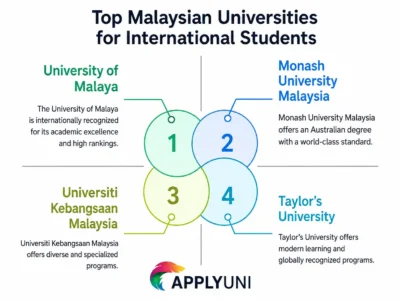
University of Malaya (UM) – Ranking: 60 Globally
- Best Majors: Medicine, Engineering, Sciences
- Fees: $3,000-6,000 Annually
- Note: Strong competition for seats
Universiti Kebangsaan Malaysia (UKM) – Ranking: 159 Globally
- Best Majors: Pharmacy, Law, Life Sciences
- Fees: $3,500-6,500 Annually
Universiti Teknologi Malaysia (UTM) – Ranking: 188 Globally
- Best Majors: Engineering, Architecture, Technology
- Fees: $4,000-7,000 Annually
Private Universities (Easier Admission, Slightly Higher Fees):
Monash University Malaysia – Branch of Monash University Australia (Ranking: 42 Globally)
- Best Majors: Medicine, Engineering, Business
- Fees: $8,000-12,000 Annually
- Advantage: Get an Australian degree at Malaysian cost
Taylor’s University – Ranking: 251-300 Globally
- Best Majors: Hospitality (#16 Globally), Business, Design
- Fees: $5,000-9,000 Annually
- Modern environment and excellent facilities
Sunway University
- Best Majors: Business, Media, Tourism
- Fees: $5,500-8,500 Annually
- Partnerships with Lancaster and Le Cordon Bleu
INTI International University
- Best Majors: Business, IT, Engineering
- Fees: $4,500-8,000 Annually
- Twinning programs with British universities
Multimedia University (MMU)
- Best Majors: Computer Science, Digital Engineering, Design
- Fees: $4,000-7,500 Annually
- First private technical university in Malaysia
MAHSA University
- Best Majors: Medicine, Nursing, Pharmacy
- Medicine Fees: $8,000-10,000 Annually (Cheaper than most countries)
SEGi University
- Best Majors: Business, Engineering, Aviation
- Fees: $4,500-8,000 Annually
- They have a distinguished aviation program
Asia Pacific University (APU)
- Best Majors: Cybersecurity, AI, Data Science
- Fees: $5,000-9,000 Annually
- Specialized in modern technology
Important Tip: Public universities are cheaper but admission is limited for international students. Private ones are easier in admission and offer more international programs. If you want to apply to any of these universities or have questions and want to get a consultation, we offer you a free consultation. You can book a consultation now.
Why We See Malaysia as the Best Choice for University Study
After all the previous comparisons, let’s be clear: if you’re looking for the best value for money, Malaysia is the logical choice.
This is not bias, but a simple calculation:
- A globally recognized degree from branches of prestigious British and Australian universities (Monash, Nottingham) – same curriculum, same degree, but at half the cost or less.
- Total cost of $10,000-15,000 annually (study + living) compared to $40,000-70,000 in America or Britain. This is a difference of $120,000-220,000 over 4 years – an amount enough to buy a house or start your own business.
- Safe and stable environment – Malaysia is one of the safest countries in Asia, and a multicultural society (Malay, Chinese, Indians, Arabs) makes integration easy and natural.
- English language everywhere – study, daily interaction, even street signs. You won’t need to learn a new language.
- Fast admission procedures – admission takes only 2-4 weeks, compared to 3-6 months in Western countries.
We at ApplyUni help hundreds of students annually secure their seats in the best Malaysian universities, and we see with our own eyes how their lives change for the better. If you’re serious about your future but your budget is limited, Malaysia is not just a good choice – it’s the smart choice.
Book your consultation now
Cost of Study and Living in Malaysia for International Students
Let’s talk about each part in detail and clarify every detail. How much will you actually pay? Here are the real numbers.
Annual Tuition Fees:
- Business Administration and Information Technology: $3,500 – $8,000
- Engineering: $5,000 – $10,000
- Medicine: $8,000 – $15,000
- Design and Arts: $4,000 – $7,500
Monthly Living Costs:
Final Calculation (Annually)
- Tuition Fees: $3,000 – $15,000
- Living: $4,380 – $8,280
- Health Insurance and Visa: $350 – $700
Annual Total: $8,000 – $24,000
Quick Comparison
- Malaysia: $8,000 – $24,000 Annually
- USA or UK: $40,000 – $75,000 Annually
- Difference over 4 years: Saving $120,000 – $200,000
You can reduce costs by 20-30% if you live on campus and cook your food. Most universities offer scholarships that reduce fees by 15-50% for high achievers.
Read also: Cost of Living in Malaysia for Students
How to Get University Admission in Malaysia Easily
Getting university admission in Malaysia is simpler than you think. Procedures are clear and the time frame is short compared to other countries.
Required Documents for Application
- High school certificate or equivalent (translated to English and certified)
- Academic transcript (last three years)
- Passport (valid for at least 18 months)
- Personal photos with white background (passport size)
- English proficiency certificate (IELTS 5.0-6.0 or TOEFL)
- Some universities accept without IELTS if your previous study was in English
- You can study a preparatory language program at the university itself
Note: Required documents may vary slightly by university and major, especially for medical and engineering programs. You can contact us to clarify all the details you need and help you for free.
Tips for Choosing the Right Country for University Study
Tips for choosing the right country for university study. After all the previous information, here’s what you should do before making the final decision:
- Verify university accreditation in your country: Not all universities are recognized. Check the list of accredited universities on your country’s Ministry of Education website before applying. An unrecognized degree means 4 wasted years.
- Calculate the real budget for the full 4 years: Don’t look only at the first year. Calculate tuition fees, accommodation, food, transportation, insurance, annual flight tickets, and add 10-15% for emergencies. The important question: Does your budget cover the entire period?
- Language and job opportunities after graduation: Is study in English? Can you work during study? What’s the work visa duration after graduation? Canada gives you 3 years, Australia two years, Malaysia is limited. Think about your post-graduation plans now.
- Choose an environment that suits your personality: Weather, culture, distance from your country, lifestyle. These are not small details, but factors that affect your academic success and psychological comfort for 4 years.
- Read real student experiences: Search in Facebook groups, ask students currently studying at the same university. Real experiences are more important than all advertisements.
The best country for you is not the most expensive or famous, but the one that suits your budget, goals, and personality. Take your time in comparison, the right decision saves you years and a lot of money.
Need help choosing? We offer you at ApplyUni a free consultation based on your personal situation and career goals.
FAQ
What are the best countries for university study?
Among the top countries: United States, United Kingdom, Canada, Australia, and Malaysia. Each country has its advantages, and the choice depends on your budget and career goals.
Is Malaysia among the countries with internationally recognized degrees?
Yes, Malaysian universities are accredited by MQA (Malaysian Qualifications Agency) and recognized in most countries of the world, especially Europe, Asia, Australia, and Gulf countries. Check the list of accredited universities in your country before applying.
What is the cost of study and living in Malaysia?
Tuition fees: $3,000 – $15,000 annually depending on the major. Living: $400 – $700 monthly. Annual total: $8,000 – $24,000.
What are the best Malaysian universities for international students?
University of Malaya, Monash Malaysia, Taylor’s, Sunway, UTM, UKM, INTI, MMU, MAHSA, SEGi, and APU. Each university has strong majors, and the choice depends on your field of study.
How do I apply to a university in Malaysia?
Prepare your documents (high school certificate, passport, language certificate), apply through the university website or an accredited agent, wait for admission (1-3 weeks), pay initial fees, get student visa (4-8 weeks). Total duration: 8-12 weeks.
Can I study in Malaysia without IELTS?
Yes, if your previous study was in English or you can pass the university’s language test. Some universities offer a preparatory language program before starting the major.