احدث المقالات
Best Mechanical Engineering Specializations – 4 Fields

In a world racing toward the Fourth Industrial Revolution, the best mechanical engineering specializations emerge as a golden gateway to an exceptional professional future. From mechatronics and robotics to sustainable energy and electric vehicles, these specializations are witnessing 15-20% annual growth. In this guide, we reveal the secrets to choosing the right specialization, engineer salaries in Saudi Arabia and the UAE, and the best internationally accredited universities. Your future starts here.
Does Mechanical Engineering Have a Future?
When you ask about the future of mechanical engineering, the answer is clear: yes, the future is very promising!
Mechanical engineering is experiencing accelerated growth with the development of robotics, renewable energy, and electric vehicles. Projections indicate 19,000 new jobs will be created annually on the global level.
In the Gulf region specifically:
- Saudi Arabia: Vision 2030 supports growing demand for mechanical engineers in oil, energy, and industrial sectors
- Starting salaries reach SAR 18,000 for fresh graduates
- Diverse job opportunities in mega-projects and smart cities
Mechanical engineering focuses on the design, analysis, and maintenance of mechanical systems and machines, making it one of the most diverse and in-demand engineering specializations in the job market.
Best Mechanical Engineering Specializations in Demand
Before I tell you about the best mechanical engineering specializations and help you choose yours, ask yourself: which of these specializations will make me in demand in the job market five years from now?
The answer is not one, but four golden paths experiencing exceptional growth of 15-20% thanks to Industry 4.0. Let me reveal these treasures:
1. Mechatronics and Robotics Engineering
Imagine designing a robot that thinks and moves.
That is exactly what mechatronics engineering does — it combines mechanics, electronics, and programming to create intelligent systems.
A real-world story:
Tesla’s factory in Berlin uses more than 750 robots. Who designed them? Mechatronics engineers. In Saudi Arabia, NEOM’s mega-projects need thousands of engineers to design fully smart cities.
If you enjoy:
- Solving complex problems
- Programming and design together
- Seeing your ideas turn into real machines
Golden tip: UTM University in Malaysia offers programs accredited by the Board of Engineers Malaysia BEM, and its degrees are recognized in Gulf countries. Study cost? 60% less than European universities with the same global accreditation quality.
2. Renewable and Sustainable Energy Engineering
The question being asked now: how do we obtain unlimited clean energy?
If this issue occupies your thinking, you are in the right place.
Striking facts:
- Saudi Arabia is investing $500 billion in green energy
- NEOM project will operate entirely on renewable energy
- The UAE plans to produce 50% of its energy from clean sources by 2050
What you will learn in this specialization:
- Designing giant solar power stations
- Developing offshore wind turbines
- Advanced energy storage systems
- Geothermal energy (the latest globally)
Why this specialization is in high demand:
Because Gulf countries recognize one truth: oil will not last forever. The shift to clean energy is not a choice, but a strategic necessity.
Available positions:
- Solar energy systems design engineer — starting salary: SAR 15,000-20,000
- Wind turbine engineer — starting salary: SAR 16,000-22,000
- Renewable energy consultant — salary: SAR 20,000-30,000
A distinguished study destination: UNITEN University in Malaysia specializes in energy engineering and has geothermal energy laboratories — the technology of the future that is not taught in most Arab universities.
3. Computer-Aided Design and Manufacturing Engineering (CAD/CAM)
Did you know that every product you use today passed through the hands of a CAD/CAM engineer?
From your mobile phone, to your car, to the airplane you traveled on — all of them began as a digital design on a CAD program.
What distinguishes this specialization:
- You do not just design — you transform ideas into manufacturable products
Tools you will master:
- AutoCAD — the universal language of engineers
- SolidWorks — for designing complex products
- CATIA — used in aviation manufacturing
- FEA software — for digitally testing a product before manufacturing it
Why the growth rate is 12% annually:
Because every manufacturing company needs CAD/CAM engineers. Not a choice, but a fundamental necessity.
A real scenario:
Boeing is designing a new aircraft. Before any part is manufactured, it is designed with extreme precision on CAD programs. The strength under pressure, heat, and vibrations is tested — all digitally. This saves millions of dollars.
Career opportunities:
- Industrial product designer
- Manufacturing engineer
- Simulation and analysis engineer
- Smart manufacturing consultant
Why Malaysia? Monash Malaysia (a branch of the prestigious Australian university) provides advanced FEA laboratories and modern industrial equipment. You study with Australian quality, paying far less than in Australia.
4. Automotive and Vehicle Engineering
The car you drive today will become a historical relic in 10 years. Why? Because the revolution of electric and self-driving vehicles is completely changing the rules of the game.
Remarkable figures:
- 2025: 20% of cars sold globally are electric
- 2030: 50% of cars will be electric or hybrid
- 2035: most countries will ban the sale of petrol cars
What this means for you as an engineer?
Enormous job opportunities in:
- Designing electric battery systems
- Developing high-efficiency electric motors
- Self-driving systems and artificial intelligence
- Safety and security engineering
Gulf demand:
Qatar, the UAE, and Saudi Arabia are investing billions in electric vehicle infrastructure:
- Fast charging stations
- Local electric vehicle assembly factories
- Smart transportation technology development
Attractive salaries:
- Electric vehicle engineer: SAR 18,000-25,000
- Self-driving systems engineer: SAR 22,000-35,000
- Vehicle development project manager: SAR 30,000-50,000
An exceptional study opportunity: Heriot-Watt University in Malaysia (a prestigious British university) focuses on developing self-driving vehicle systems. Its students work on real projects with global companies.
What Are the Fields of Mechanical Engineering?
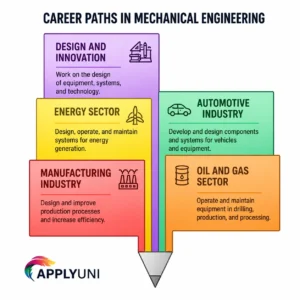
Career paths in mechanical engineering
The fields of mechanical engineering are vast, with engineering specializations spanning diverse work areas:
Main fields:
- Manufacturing and processing industries: designing and developing industrial machinery and equipment, and managing production operations
- Oil and gas sector: maintaining and operating mechanical equipment and systems in oil fields and refineries
- Energy sector: working in conventional and renewable power plants, including designing, operating, and maintaining power generation systems
- Automotive industry: developing and designing vehicle components and engines
- Construction and contracting: working on air conditioning and cooling systems
The specialization covers the design, manufacturing, operation, and maintenance of mechanical systems.
What Is a Mechanical Engineer’s Salary?
The question in your mind right now is an investment in your professional future. Let us answer it directly.
- In Saudi Arabia: a fresh graduate mechanical engineer starts with SAR 7,691 per month, rising to an average of SAR 8,905, while experienced engineers earn between SAR 11,847 and SAR 32,000 per month, especially in oil and renewable energy sectors with Vision 2030
- In the UAE: salaries range from AED 8,000 to AED 15,000 for beginners, rising to AED 25,000 – AED 45,000 per month for experts, with the highest returns in aviation, energy, and major projects sectors
- Globally: a mechanical engineer earns an annual income ranging from $80,000 to $120,000, and this figure multiplies with precision specializations such as mechatronics and sustainable energy
The bottom line? Your salary is not a fixed number, but a direct reflection of your ambition, specialization, and the university you choose to build your future.
What Are the Admission Requirements for Studying Mechanical Engineering for International Students?
The path to your engineering dream is simpler than you imagine. You need a high school certificate with a grade of 80% or above in science subjects, an IELTS score of 6.0 or equivalent, and sometimes a personal interview that measures your passion for the specialization.
In Malaysia specifically, you can apply through the UPU government system or Open Channel for private universities, with study costs ranging between $5,000 and $10,000 annually — a figure that equals one-third of the cost of studying in Europe with the same international accreditation quality.
Book a free consultation with ApplyUni now to know all the details you need.
How to Choose the Right Mechanical Engineering Specialization for You
Choosing a specialization is not a random decision, but a roadmap for your future. Start by assessing your true interests: are you passionate about robotics and artificial intelligence? Or do you find yourself drawn to sustainable energy solutions?
- Research the job market: follow Vision 2030 projects and NEOM initiatives — they tell you which specializations are in highest demand. Try before you decide: summer internships or workshops give you real-world experience
- Malaysia offers you this ideal combination: internationally accredited practical programs, with training opportunities at global companies, at costs suitable for Gulf families
Does Studying Mechanical Engineering Differ from Country to Country?
Yes, and the difference is fundamental. Malaysia, for example, focuses on automation and sustainable energy with practical applied curricula over 4 years of bachelor’s study, with Washington Accord accreditation that guarantees you can work in any country globally.
Unlike Europe, which tends toward the theoretical and research side, Malaysia produces an engineer ready for the job market from day one, with technical skills and laboratories equipped with the latest technologies.
Best Mechanical Engineering Specializations That Malaysian Universities Excel In
Malaysia is not just a study destination, but a center of excellence in specific specializations:
- Mechatronics and Robotics: UTM University is a pioneer with advanced artificial intelligence laboratories
- Sustainable Energy Engineering: UNITEN specializes in geothermal energy systems
- Computer-Aided Design CAD/CAM: Monash Malaysia with global FEA technologies
- Automotive Engineering: Heriot-Watt develops self-driving systems
The Malaysian Academic Environment for Engineering
Imagine studying at a QS Rankings-ranked university surrounded by 40,000 students, 30% of them international from 80 countries, in an Islamic environment that respects your values and culture.
Universities like University of Malaya offer modern laboratories, partnerships with global companies, and low living and study costs compared to the West. Here, you will not feel like a stranger — you will find yourself in a natural extension of the Gulf environment, with a wide gateway to the world.