احدث المقالات
Admission Requirements for Malaysian Universities 2026


Are you considering studying in Malaysia? If you are looking for an excellent university education at an affordable cost, you are in the right place.
Malaysia has become one of the most sought-after study destinations for Arab and international students, and the reason is simple: globally recognized universities, affordable tuition and living costs, and a vibrant Asian environment that combines modernity and cultural diversity.
But the most important question is: What are the Admission Requirements for Malaysian Universities?
In this comprehensive guide, we will explain everything you need to know about the admission requirements for 2026, starting from the required documents, through English language conditions, to the final application steps before your travel.
Why Choose to Study in Malaysia? 5 Real Advantages That Make It Your Ideal Destination
- Global Academic Recognition: Many Malaysian universities, both public such as Universiti Malaya (UM) and Universiti Putra Malaysia (UPM), and private, consistently rank high in global QS rankings, ensuring the value of the degree and the quality of education provided.
- Economic Costs: Tuition fees and living costs in Malaysia are much lower compared to traditional study destinations in the West, providing an excellent educational opportunity at affordable costs.
- Multicultural Environment: Malaysia offers a rich educational environment with cultural and ethnic diversity, which enhances cross-cultural communication skills and qualifies students for the global job market.
- English as the Language of Instruction: English is widely used as the primary language of instruction in most university and postgraduate programs, which facilitates the academic integration process for international students.
- Easy Visa Procedures: The process of obtaining a Student Pass is clear and organized through the Education Malaysia Global Services (EMGS) system.
What are the Admission Requirements for Malaysian Universities 2026?
Admission requirements vary depending on the study level and specialization, but general criteria can be identified for 2026.
- Bachelor
Bachelor’s Degree: Basic requirements: Secondary school certificate or its equivalent such as A-Levels, IB, Diploma with a cumulative GPA of not less than 2.50 out of 4.00. Competitive specializations such as medicine and engineering may require higher grades.
- Master’s Degree: Basic requirements: Bachelor’s degree from a recognized university, with a cumulative GPA of not less than 2.75 out of 4.00. Work experience or recommendation letters may be required.
- Doctorate: Basic requirements: Master’s degree from a recognized university, in addition to a detailed and strong Research Proposal. Emphasis on the student’s research record in the previous stage.
We always advise students to review the specific requirements of their chosen program. Conditions may vary slightly between public and private universities.
Read also: Scholarships in Malaysia Bachelor 2026
English Language Requirements for Studying in Malaysian Universities
One of the most common questions when searching for Admission Requirements for Malaysian Universities is: Is English language mandatory? The short answer: Yes, but there are flexible alternatives!
Required Scores in English Language Tests
Language requirements vary depending on the study level and university, but these are the generally accepted standards:
IELTS Test (Most Accepted)
- Bachelor’s Degree: Score 5.5 to 6.0 (depending on specialization)
- Master’s and Doctorate: Score 6.0 to 6.5
TOEFL iBT Test
- Bachelor’s Degree: 60 – 80 points
- Postgraduate Studies: 80 – 90 points
MUET Test (Malaysian Local)
- Bachelor’s Degree: Band 3 or Band 4
- Postgraduate Studies: Band 4 or Band 5
Important Note: Medical, engineering, and pharmacy specializations usually require higher scores (IELTS 6.5 or more).
Required Documents for Application to Malaysian Universities
A successful application requires preparing a set of essential documents, all of which must be certified and translated into English.
- Passport: A clear, colored copy of all passport pages, valid for at least 18 months.
- Academic Certificates: Certified copies of graduation certificates and transcripts for previous academic stages.
- Personal Photo: Recent passport-sized photos with a white background.
- English Language Proficiency Certificate: A copy of the IELTS or TOEFL certificate or its equivalent.
- Curriculum Vitae (CV): Particularly required for postgraduate programs.
- Motivation Letter/Personal Statement: Explains the student’s academic and professional goals, essential for Master’s and PhD programs.
- Research Proposal: An essential document for PhD and research Master’s programs.
- Medical Report: A health certificate proving the student is free from infectious diseases.
- Proof of Financial Capability: A bank statement showing the ability to cover tuition fees and living costs.
How to Choose Globally Recognized Malaysian Universities
To ensure obtaining a globally valuable degree, specific criteria must be followed when choosing a university.
- Global University Rankings: Rely on reputable rankings such as QS World University Rankings or Times Higher Education. Malaysian universities that appear in these rankings have a strong academic reputation.
- Local Accreditation (MQA): Ensure that the program and specialization are accredited by the Malaysian Qualifications Agency (MQA), which guarantees local and international recognition of the degree.
- International Branch Campuses: Consider Malaysian branches of international universities such as Monash University Malaysia or University of Nottingham Malaysia, which offer the same curricula and original degrees at lower costs.
- Specialization and Scientific Research: Choose a university strong in the required specialization, and review its research record and faculty-to-student ratio.
Cost of Study and Living in Malaysia 2026
Admission requirements to Malaysian universities
Costs in Malaysia are low compared to many other countries, making it a suitable choice:
- Tuition Fees:
Annual estimate: $3,000 – $25,000 USD.
Notes: Fees vary significantly depending on the university, specialization, and study level.
- Living Costs:
Annual estimate: $5,500 – $10,000 USD.
Notes: Includes rent, food, transportation, and personal expenses.
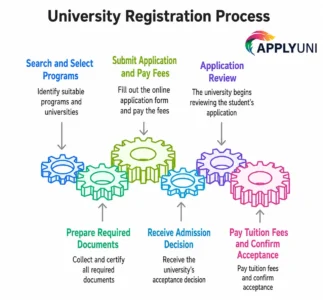
Steps to Register in Malaysian Universities
- Research and Program Selection: Determine the appropriate specialization and university based on qualifications and budget.
- Document Preparation: Collect, certify, and translate all required documents mentioned above.
- Application Submission and Fee Payment: Fill out the online application form for the chosen university and pay the non-refundable application fee.
- Obtaining the Offer Letter: After reviewing the documents, the university issues an Offer Letter, which may be conditional or unconditional.
- Payment of Fees and Confirmation of Admission: Pay the first installment of tuition fees to confirm admission and begin travel procedures.
Application Deadlines for Malaysian Universities
Malaysian universities are flexible with admission deadlines, with several intake periods throughout the year:
- Main Intake (Fall): Starts in September-October.
- Winter Intake: Starts in January-February.
- Summer Intake: Starts in May-July.
It is advisable to apply 3 to 6 months before the specified date, especially since visa procedures may take a long time. Public universities open applications 6-10 months before the start of studies.
Read also: Application Deadlines for Malaysian Universities
How to Get Admission to English Language Institutes in Malaysia
If your English language proficiency score does not meet direct admission requirements, enrolling in a language institute is the ideal solution.
- Choosing an Accredited Institute: You must choose a recognized institute, preferably affiliated with the university you intend to study at.
- Registration and Placement Test: Registration is done directly at the institute, and you may be required to take a test to determine the appropriate level to start.
- Conditional Admission: You will receive a conditional admission from the university, stating that your final admission is granted after you pass the required level in the Intensive English Program (IEP).
- Visa Procedures: The institute arranges your Student Pass, which is later converted to a university visa after completing language studies.
Tips for Quick and Easy Admission to Malaysian Universities
To ensure a quick and easy admission process, it is advisable to follow these guidelines:
- Accuracy and Completeness of Documents:
Ensure that all required documents are complete, certified, and professionally translated, as incomplete documents or errors in them are among the main reasons for delaying admission procedures. - Early Application:
It is preferable to apply at the beginning of the registration period, as this gives your application priority in review and provides sufficient time to complete visa procedures, which may take a long time. - Focus on Private Universities:
Sometimes, admission procedures in private universities are faster and more flexible compared to public universities. - Effective Communication:
Ensure continuous and professional communication with the university’s admission office or educational consultant to follow up on your application regularly.
How ApplyUni Helps You Secure Guaranteed University Admission in Malaysia
The process of applying to international universities, especially regarding EMGS visa procedures, can be complex and time-consuming. This is where the role of a specialized educational consultant like ApplyUni comes in, as we provide you with integrated support to ensure you secure guaranteed university admission in Malaysia:
- Academic Consultation:
We help you choose the most suitable university and specialization for your qualifications, budget, and career goals. - Professional File Preparation:
We ensure all your documents are complete according to admission requirements, and we handle the necessary auditing and certification processes. - Admission and Visa Follow-up:
We handle direct communication with the university and EMGS to follow up on the admission application and Visa Approval Letter (VAL) procedures until final approval is issued. - Saving Time and Effort:
Thanks to our extensive experience in the Malaysian educational system, we guarantee you university admission in the shortest possible time and with the least effort.
What to Do Before Traveling to Study in Malaysia
After obtaining the Visa Approval Letter (VAL), the final stage begins, requiring careful planning before travel:
- Accommodation Confirmation:
Book temporary or permanent accommodation, either on-campus or off-campus, to ensure a place to stay upon arrival. - Flight Ticket:
Book your flight ticket and coordinate your arrival time with the university in advance. - Health Insurance:
Ensure you have health insurance covering the entire study period, as most universities require it as a basic condition. - Documents in Hand Luggage:
Keep all original and important documents in your hand luggage, such as passport, offer letter, VAL letter, bank statement, and medical report, for easy presentation upon arrival. - Contact the University to Arrange Reception:
Inform the university of your arrival time to arrange airport reception, which is mandatory in Malaysia to facilitate immigration procedures.
Frequently Asked Questions
What are the Admission Rates in Malaysia?
There is no unified admission rate for all universities in Malaysia; requirements vary from one university to another.
General rates can be summarized as follows:
- Public Universities: Require a GPA of 70% or higher, due to high competition.
- Private Universities: Admission is more flexible, a GPA of 60% or higher is sufficient.
- Competitive Specializations such as medicine and engineering may require higher rates than general rates.
What IELTS Score is Required in Malaysia?
The required IELTS score varies depending on the university and study program, but the most common requirements are:
- Bachelor’s and General Specializations: IELTS score 5.5 – 6.0
- Master’s Programs: IELTS score 6.0 – 6.5
- Medical and Health Sciences Specializations: May require IELTS 6.5 – 7.0
Many Malaysian universities accept internal language tests (EET) or language qualification programs as alternatives to IELTS.
Does Malaysia Require Aptitude Tests for Admission?
No, Malaysia does not require aptitude or achievement tests adopted in some Arab countries.
The admission process primarily relies on:
- Academic average
- Language certificate
- Fulfillment of specific requirements for each study program