احدث المقالات
When Does University Study Start in Malaysia? 2026–2027


If you’re wondering when university starts in Malaysia, this article gives you the complete answer. Unlike most countries, Malaysia offers you four intake opportunities every year – but each one comes with its own rules. Choose the wrong one and it could cost you six months of waiting or thousands of dollars. In this comprehensive guide, you’ll discover the exact dates, the differences between public and private universities, and the best time to submit your application to secure your admission.
Why Do Students Travel to Study in Malaysia?
Picture this: you’re studying at a world-class university in a country far from your own, yet you find everything that feels like home in the Arab world – you hear the call to prayer from your bedroom window, and your favorite restaurant serving kabsa and mandi is only minutes away. This isn’t a dream – it’s Malaysia!
- Respect for Islamic culture: Malaysia is a Muslim-majority country, which makes Arab students feel comfortable and at home. Mosques are everywhere, and the call to prayer sounds right on time.
- Halal food everywhere: Restaurants and shops serve 100% halal food, and there are Arab and Gulf restaurants in the major cities.
- A mild climate: The warm, tropical weather year-round is very similar to the climate of the Gulf states, making it easy to adjust.
- High level of safety: Malaysia is one of the safest countries in Asia for international students, with very low crime rates.
- Low monthly costs: A student needs only $300 to $500 a month to live on, compared with thousands of dollars in Europe and America.
The Benefits of Studying in Malaysia
What will you really gain from studying in Malaysia?
Malaysian universities are internationally accredited and follow British and Australian standards. Universities such as Malaya, Putra, and UTM rank among the world’s top 200, and they’re recognized across all the Gulf states and the wider Arab world.
Annual tuition costs:
- Humanities: $2,500
- Engineering and IT: $3,000 – $6,500
- Medicine and pharmacy: $10,000 – $35,000
That’s 70% less than studying in Europe or America.
The academic environment includes:
- Students from more than 100 countries
- Modern labs and technology (3D printing, artificial intelligence)
- Digital libraries available 24/7
- Free high-speed internet
Official recognition is guaranteed by the education ministries of Saudi Arabia, the UAE, Kuwait, Bahrain, Oman, Qatar, and Egypt.
The Academic Year in Malaysia
Malaysia’s system is a little different from those in Arab countries, but it’s actually more flexible and gives you better options for enrolling. The structure: two academic semesters per year.
First semester (July – December):
- Starts: July/August
- Ends: December
- Includes: a mid-semester break (one week)
Second semester (February – June):
- Starts: February/March
- Ends: June
- Final exams: May and June
Summer break (June – July):
- Length: 6-8 weeks
- Ideal for going home or a summer internship
A bonus for Arab students: The academic calendar lines up perfectly with the holidays of the Gulf states, making it easy to plan family visits and travel.
When Does University Start in Malaysia? (2026-2027 Intake Dates)
This is the single most important question, and it shapes your entire plan. There isn’t just one answer – it depends on the type of university you’re targeting, and that actually works in your favor.
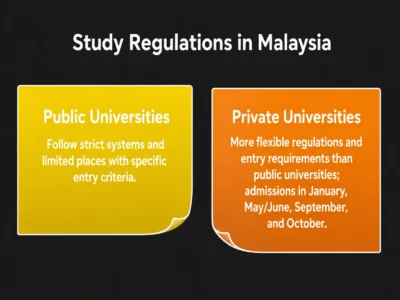
When does university start in Malaysia
Public Universities: A Strict System With Limited Opportunities
Intake dates: February and September only (two intakes per year)
Public universities such as the University of Malaya, UKM, and UPM follow a strict, fixed academic calendar. Once admissions close or the semester begins, there’s no second chance until the next intake.
Why does this matter?
- You need to submit your documents 2-3 months before the semester starts
- There’s no room for delays or postponement
- Competition is tougher because seats are limited
Private Universities: Exceptional Flexibility
Main intake dates:
- January/February – first semester
- May/June – second semester
- September/October – third semester
Additional dates at some universities:
- November (select universities)
- March (specific programs)
Major private universities such as Taylor’s University, UCSI, Sunway, Monash Malaysia, and Nottingham Malaysia give you:
the chance to enroll every 3-4 months, the flexibility to apply right up to the last minute, and the option to defer your admission if you’re not ready yet – an excellent alternative if you’ve missed the public university intake.
When Does University Study Start in Malaysia? (2026-2027)
If you miss the public university intake, don’t wait! Accredited private universities offer the same quality of education, with international partnerships and greater flexibility.
Start your application 2-3 months before your target date. A delay could cost you an entire semester.
Need help choosing the right university or applying?
Contact us now for a free consultation and fast-track registration at Malaysia’s top universities.
Can You Enroll After the Semester Has Started?
The short answer: yes, but only at private universities and under specific conditions.
Public Universities: No Room for Delay
The rule is strict: once the semester begins, admissions close completely.
What you need to know:
- Submit your documents at least two months before the semester starts
- No exceptions, even if your documents are ready
- Your only option: wait for the next semester (six months)
Private Universities: A Small Window for Latecomers
Some private universities accept late registration up to two weeks after the semester starts, but on two conditions:
- Completing all the required documents immediately
- The availability of open seats (very limited)
Universities known for accepting late enrollment:
- Sunway University
- Asia Pacific University (APU)
- HELP University
- UCSI University
Important note:
Only 30% of private universities offer this option, and seats are extremely limited. Don’t rely on it as your main plan.
Application Deadlines for Malaysian Universities
Timing is everything. Applying early doesn’t just secure your admission – it gives you enough time for your visa, housing, and preparation.
Public universities: Applications go through the online UPUOnline system and usually open about four months before the semester starts. The window runs from November to March for the September intake, and from May to August for the February intake.
Private universities: more flexible and accept applications year-round, though it’s best to apply 2-3 months before the start date.
Also read: Application Deadlines for Malaysian Universities
How Long Is University in Malaysia by Major?
The length isn’t fixed – it depends on your major and the program you choose. Here’s the complete guide:
Humanities and business majors: 2-3 years
The fastest routes to graduation!
- Business Administration
- Accounting
- Marketing
- Media and Communication
- Public Relations
The upside: some universities offer accelerated programs that let you graduate in just 2.5 years through summer study.
Engineering and computer science: up to 4 years
The standard program:
- 3.5 years of theoretical and practical study
- 6 months of mandatory industrial training at companies
Popular majors:
- Software engineering – mechanical – electrical – civil
- Computer science – artificial intelligence – information security
Learn more: The Cost of Living in Malaysia for Students
Factors That Affect How Long Your Degree Takes
Several factors determine how long it actually takes to complete your degree:
- Your chosen major: applied fields like engineering take longer than theoretical ones.
- Your course load: a student who registers for the maximum credit hours each semester finishes faster.
- Practical training: some majors require six months of mandatory training, which adds an extra semester.
- Credit transfers: students who hold a diploma or a foundation year may receive transfer credits that shorten the program.
- Academic performance: failing courses means retaking them, which delays graduation.
The Language of Instruction at Malaysian Universities
English is the official language of instruction at all private and international universities.
IELTS requirements: most universities require a score of 5.0 for humanities majors and 6.0 for engineering and health sciences.
Studying without IELTS: possible in the following cases:
- If your high school education was in English
- If you enroll in the university’s own preparatory English program
- If you pass the university’s placement test
Some universities, such as UCSI and Taylor’s, offer intensive language programs lasting three to six months.
The Most Popular Universities in Malaysia
Here’s a list of Malaysia’s top universities recognized across the Gulf:
- University of Malaya (UM): Malaysia’s number-one university, ranked among the world’s top 100.
- National University of Malaysia (UKM): specializes in medicine and engineering, and is recognized across all the Gulf states.
- Universiti Sains Malaysia (USM): strong in scientific research and technology.
- Taylor’s University: the best private university, ranked first for education quality within the country.
- UCSI University: internationally recognized, offering a wide range of programs at reasonable prices.
- Sunway University: renowned for its business and engineering programs, with partnerships with British universities.
The Best Company to Help You Get Admitted
If you’re a Saudi, Gulf, or Sudanese student looking for university admission in Malaysia, ApplyUni is your ideal partner.
We offer comprehensive services that include:
- Securing university admission from Malaysia’s best universities in the shortest possible time
- Preparing the paperwork and documents required for your application
- Obtaining your student visa and following up on the procedures
- Arranging student housing that is suitable and safe
- Full support for Saudi, Gulf, and Sudanese students from the moment they arrive until graduation
- Welcoming our students at the airport
Our team specializes in smoothing your academic journey and securing your place at the right university for your major and your budget. Contact us now and get a free consultation.
Conclusion
Now you have the complete roadmap!
The question of when university starts in Malaysia is no longer complicated. Remember: public universities start in February and September only, while private universities give you exceptional flexibility with January, May, and September intakes. The key is planning early and applying 2-3 months before your target date.
Don’t leave your dream to chance. Malaysia is waiting for you, with its globally recognized universities, affordable costs, and comfortable Islamic environment.
Ready for the next step? Contact ApplyUni now for a free consultation and lock in your seat before the deadlines pass!
Frequently Asked Questions
Do start dates differ between Malaysian universities?
Yes. Public universities start in February and September only, while private universities are more flexible and offer intakes in February, May, and September, and sometimes January and November.
How much does university cost in Malaysia?
Humanities majors start at $2,500 a year, engineering from $2,500, and medicine from $10,000 to $35,000 a year, plus monthly living costs of $250-$500.
Are Malaysian universities recognized in the Gulf?
Yes. All Malaysian universities accredited by Malaysia’s Ministry of Education are recognized in Saudi Arabia, the UAE, Kuwait, and the rest of the Arab Gulf states.
When is the best time to apply?
It’s best to apply 3-4 months before the semester start date to secure your admission and complete the visa procedures without rushing.
Can you study without IELTS?
Yes. You can enroll in the university’s own English program, or qualify if your high school education was in English, or by passing the university’s placement test.
Is studying difficult for Arab students?
Studying in English can be a challenge at first, but universities provide academic support and remedial courses. Most Arab students adjust during their first semester.
How much are living costs for an Arab student?
A student needs between $300 and $500 a month, covering housing, food, transport, and personal needs, which makes Malaysia an economical choice compared with Western countries.